B♭ Dominant 7th
B♭7
Notes
B♭ · D · F · A♭
Intervals
- RootB♭ (1P)
- Major 3rdD (3M)
- Perfect 5thF (5P)
- Minor 7thA♭ (7m)
Fretboard
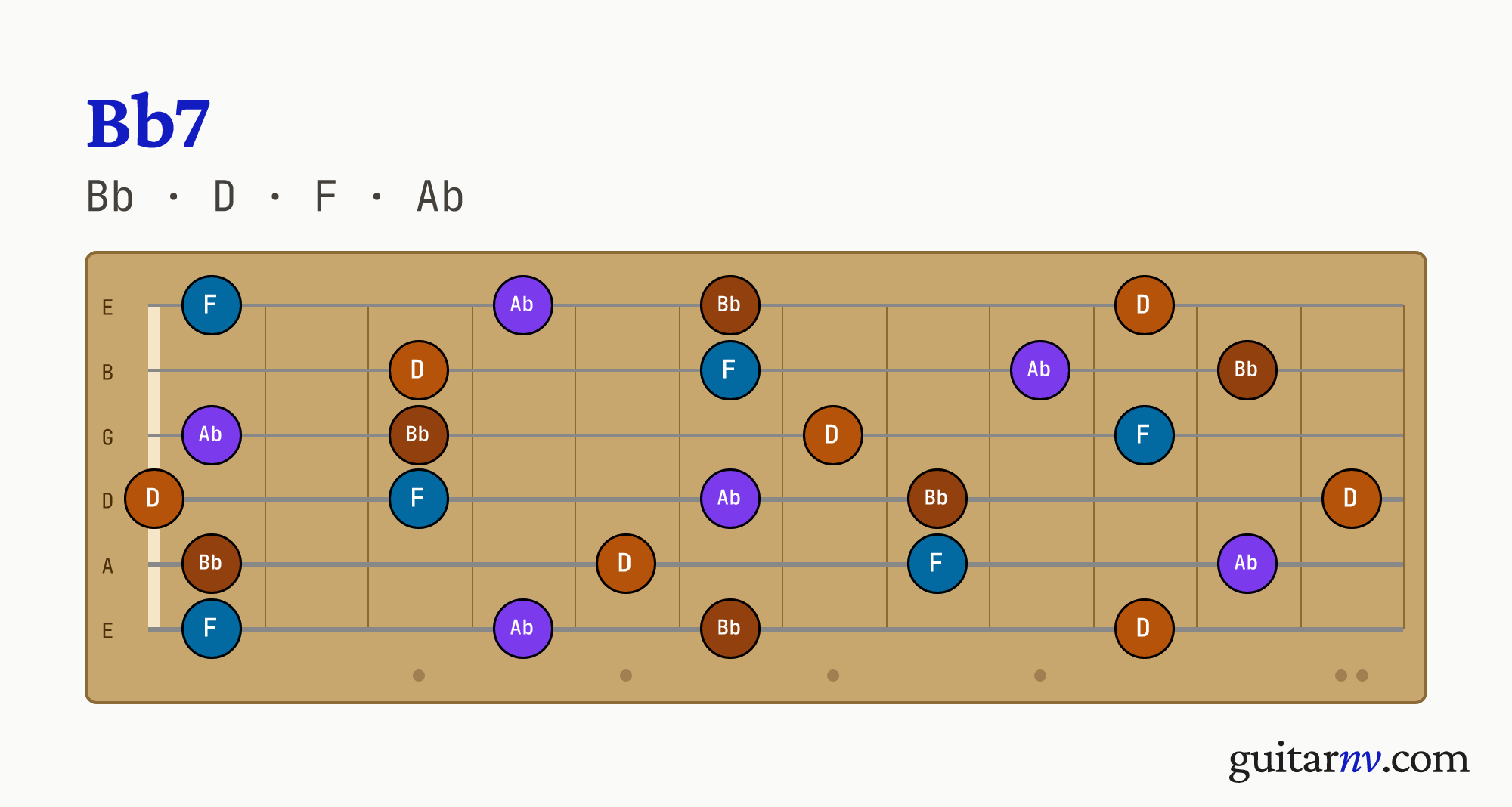
Adjust labels, frets, and palette in the interactive view.
Voicings & shapes
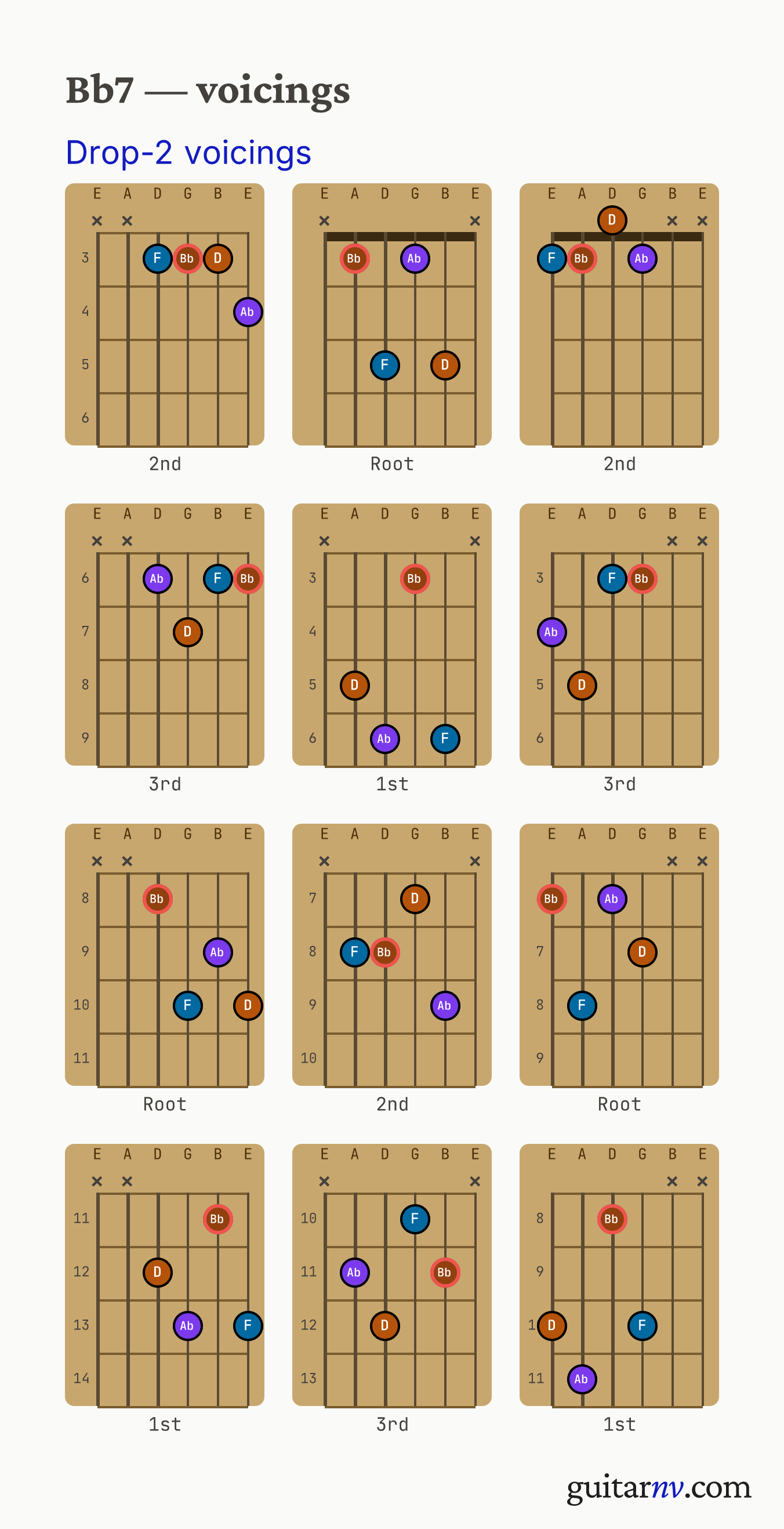
Drop-2 voicings (12)
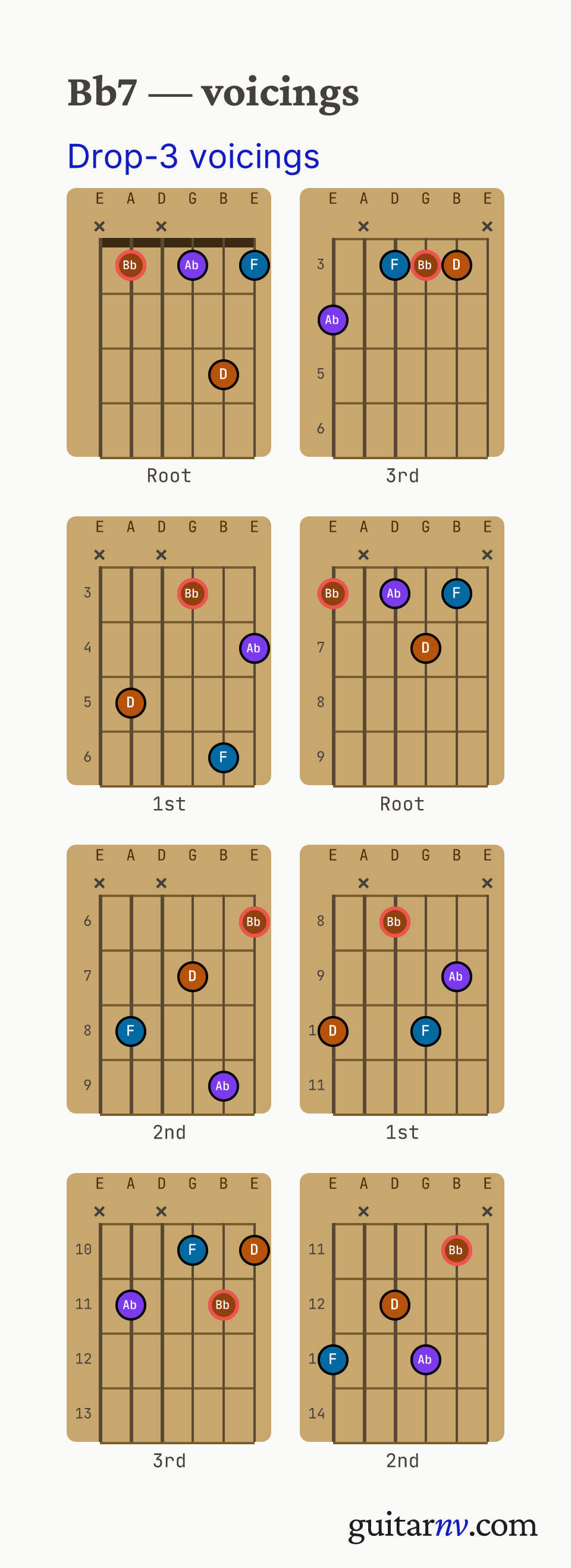
Drop-3 voicings (8)
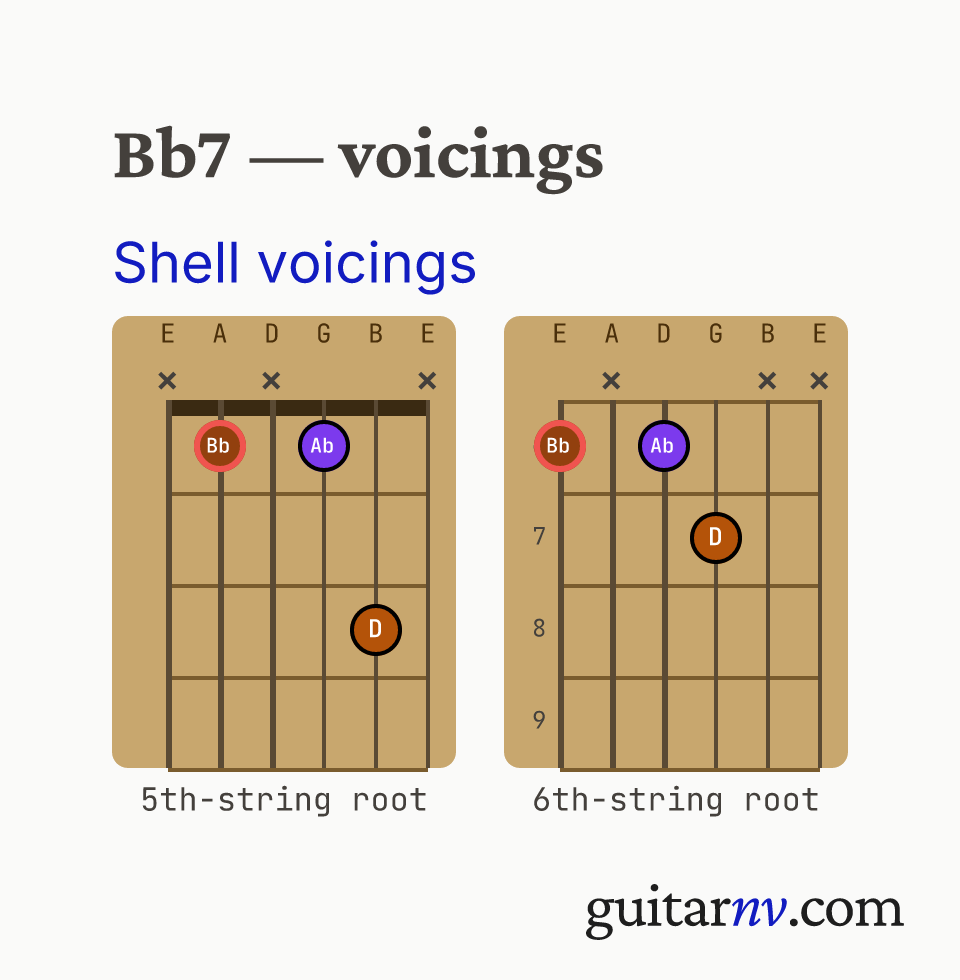
Shell voicings (2)
About
The B♭7 dominant seventh (B♭–D–F–A♭) is the primary tension-bearing chord in tonal harmony. Its pull toward resolution comes from the tritone between D and A♭ — these two notes want to resolve inward, landing in the V–I cadence on E♭. The 3rd and ♭7 are essential: they form the tritone, and they distinguish a dominant 7 from a B♭m7. The fifth can be freely omitted without weakening the harmonic function. On guitar, shell voicings (1–3–♭7) are common in jazz; full voicings appear in blues and rhythm playing. Compared to B♭Maj7, dominant 7 is harmonically active and directional — it is a chord that moves.
Chord diagrams
Bb Dominant 7th voicing charts — tap a sheet to open it full size to save or print.
Similar chords
Chords sharing two or more notes with this one, ranked by overlap.
Scales containing this chord
- B♭ Mixolydian (I)
- A♭ Diminished (deg 2)
- A♭ Lydian (II)
- B Diminished (deg 8)
- C Natural Minor (VII)
- D Diminished (deg 6)
- D Locrian (VI)
- E♭ Harmonic Minor (V)
- E♭ Major (V)
- E♭ Melodic Minor (V)
- F Diminished (deg 4)
- F Dorian (IV)
- F Melodic Minor (IV)
- G Phrygian (III)
Scales whose notes include every chord tone. The Roman numeral (or scale degree) marks the chord root’s position in the scale.