B♭ 6th
B♭6
Notes
B♭ · D · F · G
Intervals
- RootB♭ (1P)
- Major 3rdD (3M)
- Perfect 5thF (5P)
- Major 6thG (6M)
Fretboard
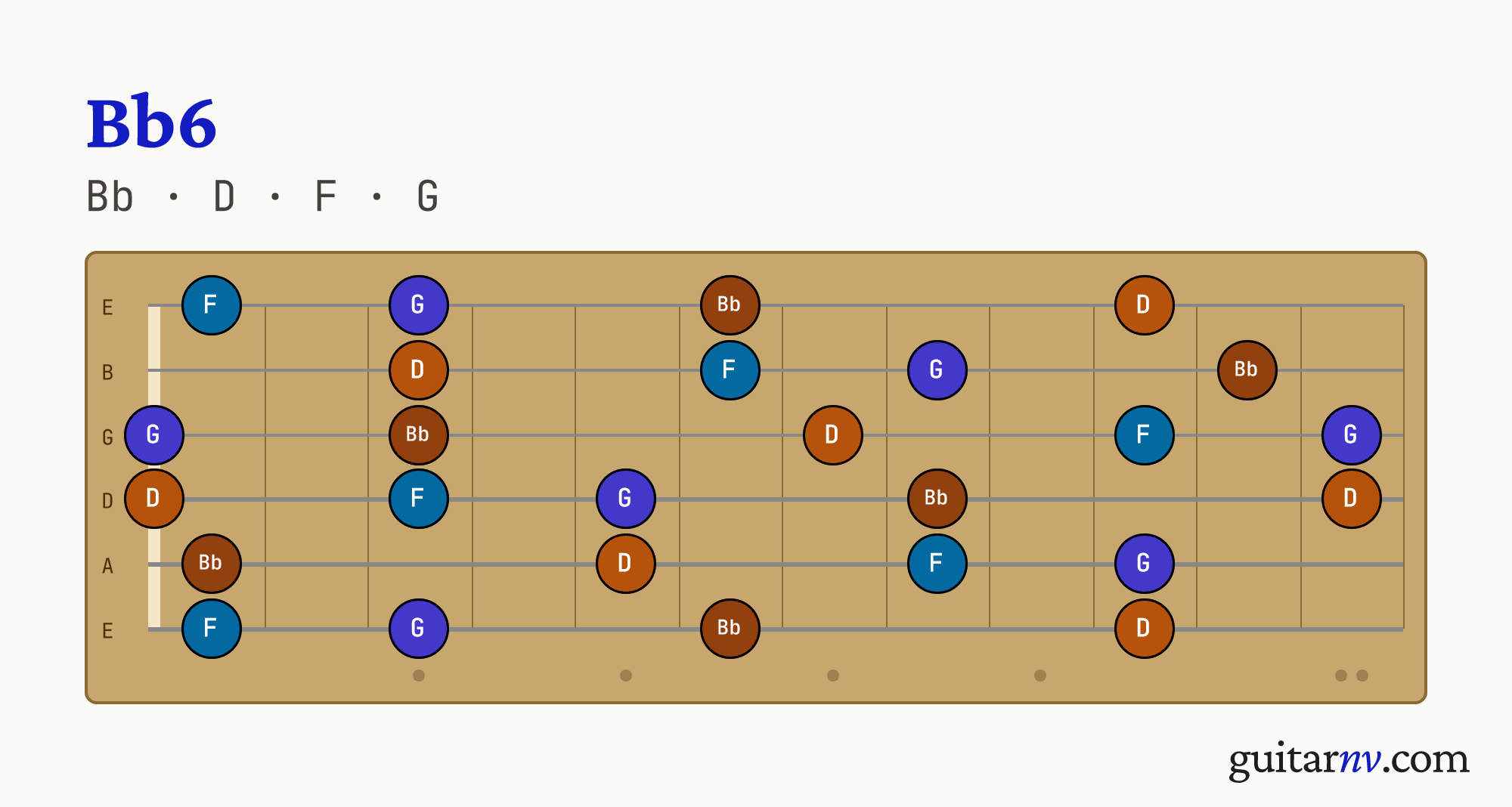
Adjust labels, frets, and palette in the interactive view.
Voicings & shapes
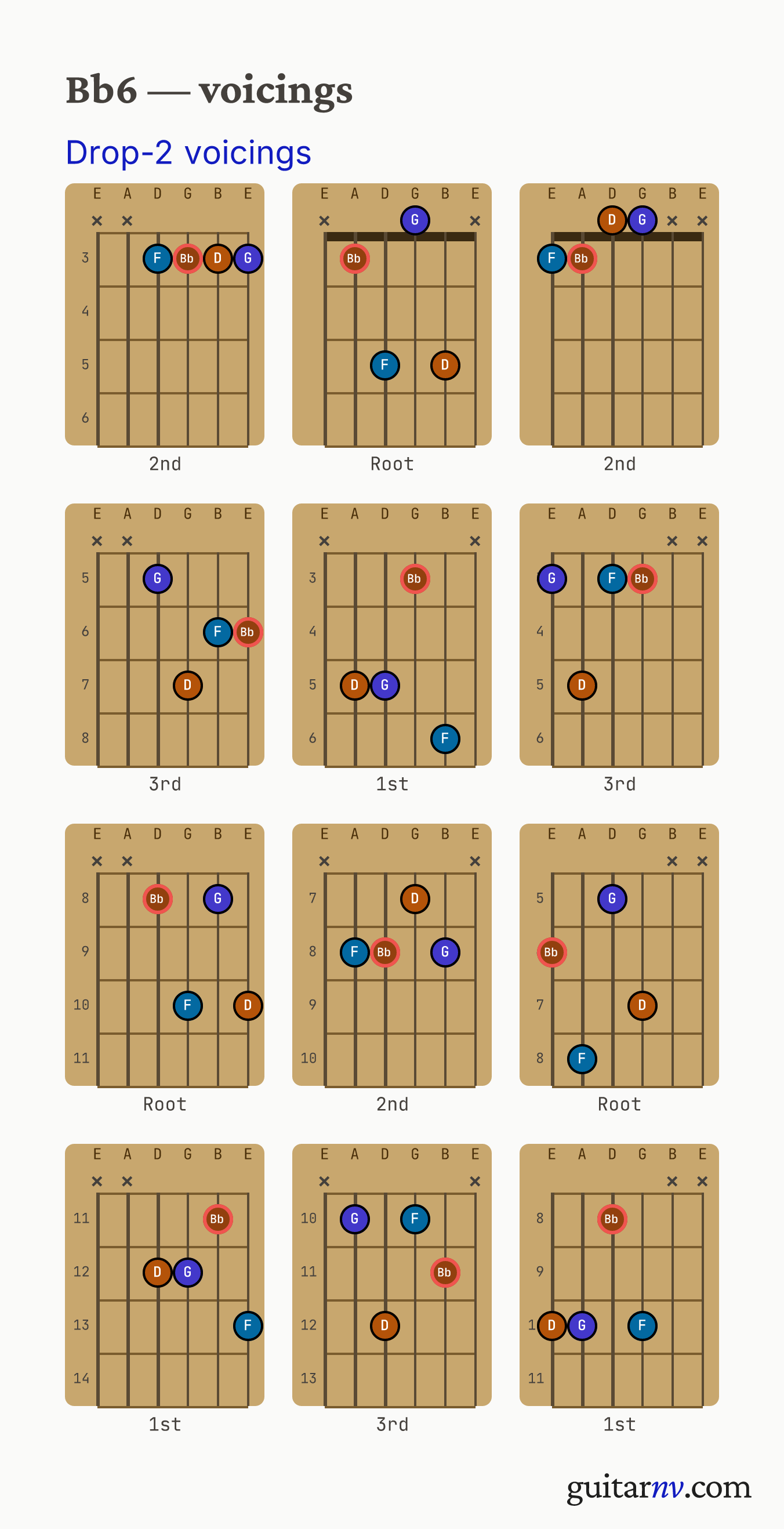
Drop-2 voicings (12)
About
The B♭6 chord (B♭–D–F–G) adds the major sixth to a major triad. The sixth is a stable, consonant addition — it does not introduce dissonance the way a 7th does — which gives 6 chords a warm, slightly vintage sound common in jazz, swing, and older pop. They can substitute for B♭ or B♭Maj7 as tonic harmony when a less tense color is wanted. The G is the defining extension; the 5th can be omitted. On guitar, 6-chord voicings tend to be compact and practical for comping. Compared to B♭Maj7, the 6 feels more grounded and less harmonically ambiguous — the 6th sits further from the root than the 7th does, so it creates no half-step tension.
Chord diagrams
Bb 6th voicing charts — tap a sheet to open it full size to save or print.
Similar chords
Chords sharing two or more notes with this one, ranked by overlap.
Scales containing this chord
- B♭ Lydian (I)
- B♭ Major (I)
- B♭ Major Pentatonic (deg 1)
- B♭ Mixolydian (I)
- A Locrian (II)
- A Phrygian (II)
- A♭ Diminished (deg 2)
- A♭ Lydian (II)
- B Diminished (deg 8)
- C Dorian (VII)
- C Mixolydian (VII)
- C Natural Minor (VII)
- D Diminished (deg 6)
- D Harmonic Minor (VI)
- D Locrian (VI)
- D Natural Minor (VI)
- D Phrygian (VI)
- E Locrian (V)
- E♭ Lydian (V)
- E♭ Major (V)
- F Diminished (deg 4)
- F Dorian (IV)
- F Major (IV)
- F Melodic Minor (IV)
- F Mixolydian (IV)
- G Blues (deg 2)
- G Dorian (III)
- G Minor Pentatonic (deg 2)
- G Natural Minor (III)
- G Phrygian (III)
Scales whose notes include every chord tone. The Roman numeral (or scale degree) marks the chord root’s position in the scale.