F♯ Augmented
F♯aug
Notes
F♯ · A♯ · C♯♯
Intervals
- RootF♯ (1P)
- Major 3rdA♯ (3M)
- Augmented 5thC♯♯ (5A)
Fretboard
On the fretboard, D represents C♯♯.
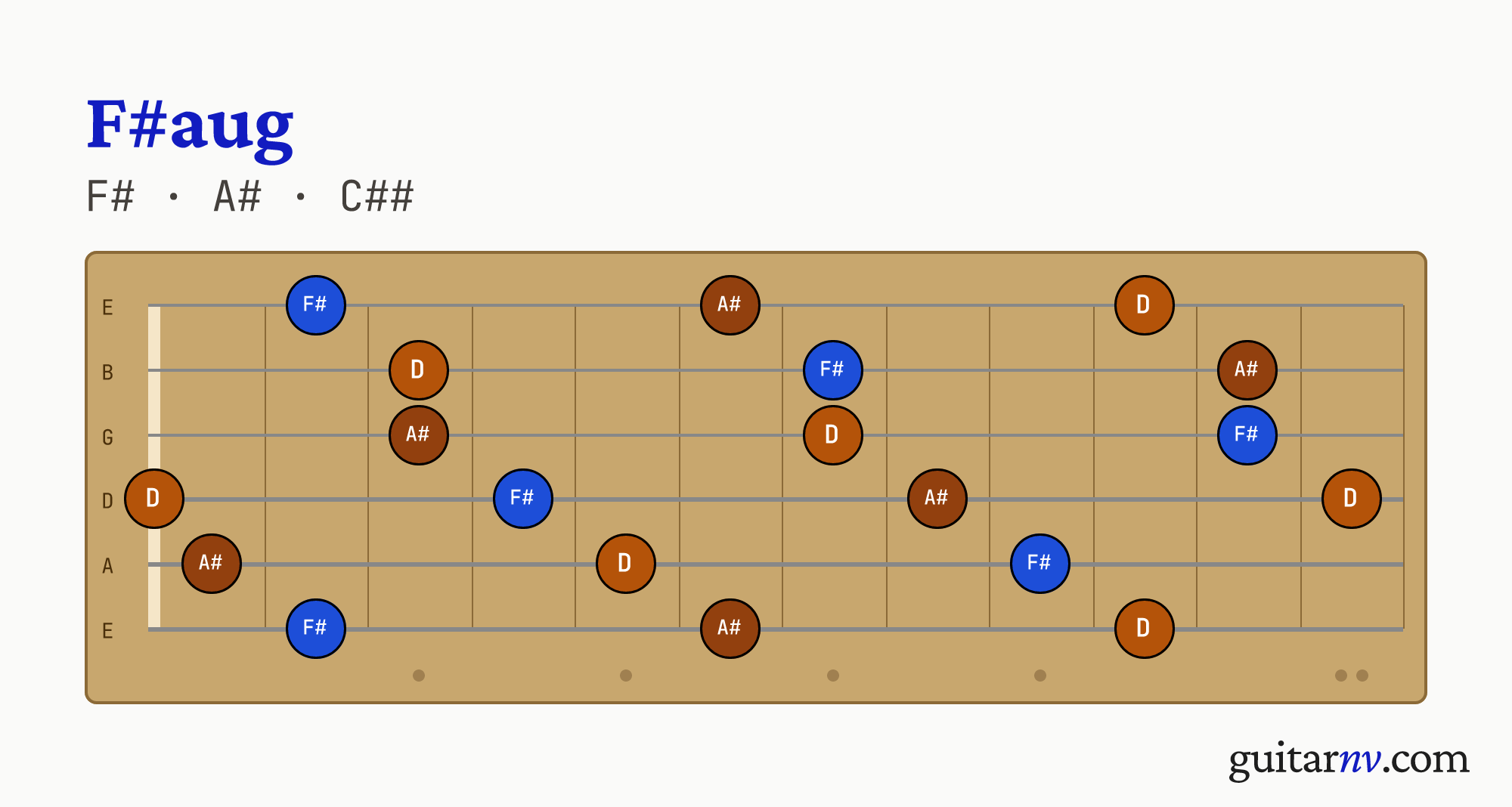
Adjust labels, frets, and palette in the interactive view.
Voicings & shapes
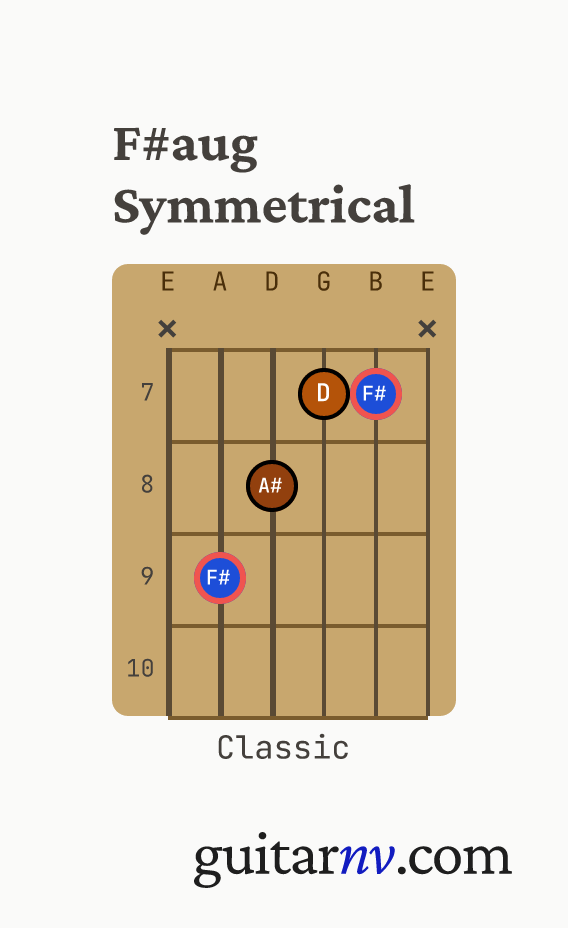
Aug symmetrical (1)
One shape moved up 4 frets gives the next enharmonic root: C, E, and A♭ augmented are the same three notes.
About
The F♯ augmented triad (F♯–A♯–C♯♯) raises the fifth by a half step, replacing the stable perfect fifth with an augmented fifth. This removes the grounding effect of the perfect fifth and gives the chord its floating, unresolved quality — every interval is a major third, making the structure symmetrical and harmonically ambiguous. It commonly appears as a passing chord between the major triad and the IV chord (F♯ → F♯+ → B), or as a V+ that creates extra tension before resolving. All three tones carry weight — omitting the C♯♯ leaves a plain major chord, so it must be present. Augmented shapes repeat every four frets. Compared to F♯dim, augmented feels more open and less tense, but equally unstable.
Chord diagrams
F# Augmented voicing charts — tap a sheet to open it full size to save or print.
Similar chords
Chords sharing two or more notes with this one, ranked by overlap.
Scales containing this chord
- F♯ Whole Tone (deg 1)
- A♭ Whole Tone (deg 6)
- B Harmonic Minor (V)
- B Melodic Minor (V)
- B♭ Whole Tone (deg 5)
- C Whole Tone (deg 4)
- D Whole Tone (deg 3)
- E Whole Tone (deg 2)
- E♭ Harmonic Minor (III)
- E♭ Melodic Minor (III)
- G Harmonic Minor (VII)
- G Melodic Minor (VII)
Scales whose notes include every chord tone. The Roman numeral (or scale degree) marks the chord root’s position in the scale.