D♭ Suspended 2nd
D♭sus2
Notes
D♭ · E♭ · A♭
Intervals
- RootD♭ (1P)
- Major 2ndE♭ (2M)
- Perfect 5thA♭ (5P)
Fretboard
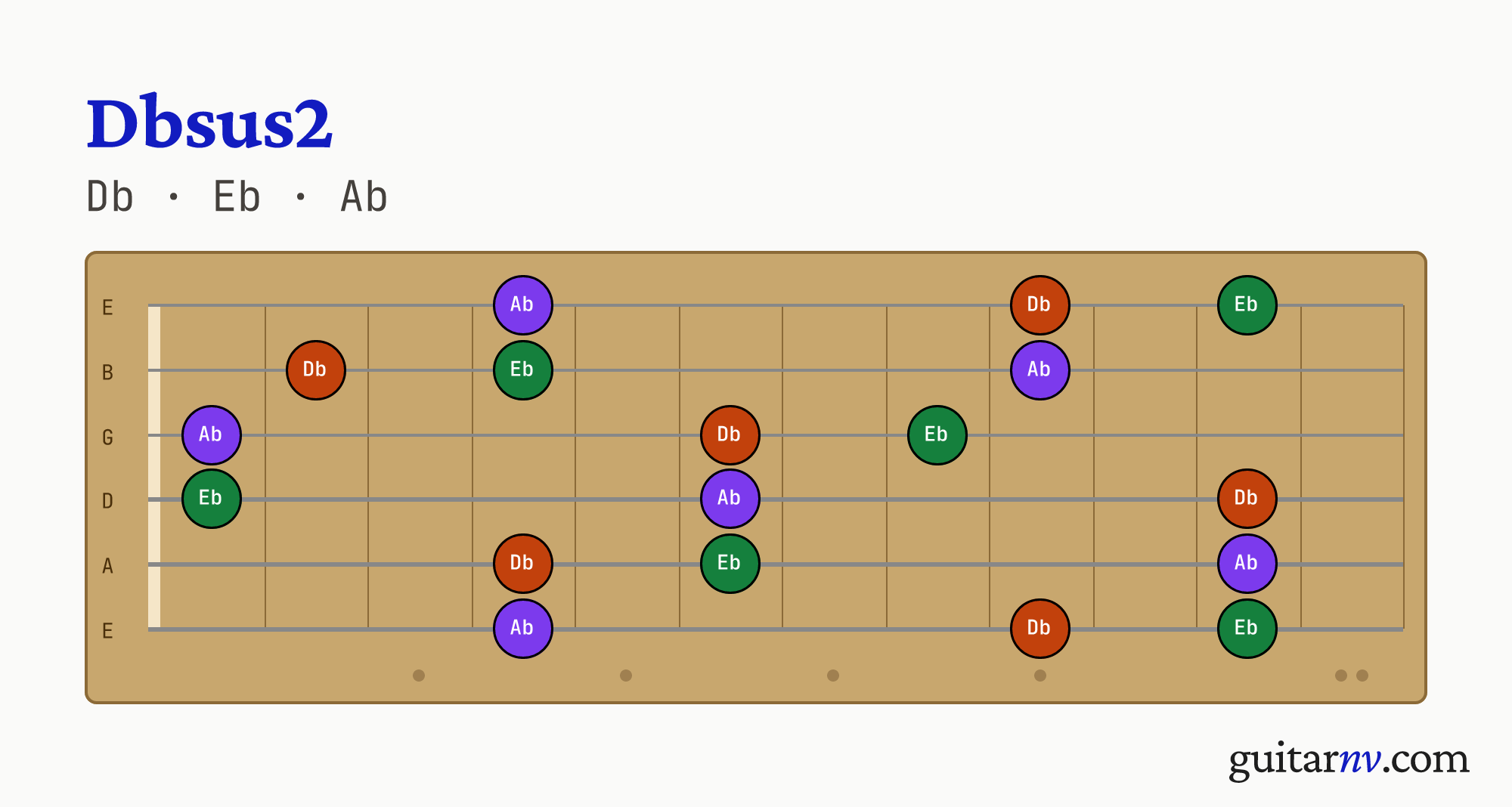
Adjust labels, frets, and palette in the interactive view.
About
The D♭sus2 chord (D♭–E♭–A♭) replaces the third with a major second, removing the major/minor distinction entirely. The sound is open and ambiguous — neither bright nor dark — which is why sus2 voicings are common in pop, rock, and worship for texture and color rather than strong harmonic function. Sus2 chords can resolve by moving the E♭ up to a major or minor third (landing on D♭ or D♭m) or simply remain static. On guitar, the omitted third creates the characteristic airiness; both the second and fifth are essential. Ringing open strings reinforce the spacious quality. Compared to D♭sus4, sus2 feels softer and less directionally tense.
Similar chords
Chords sharing two or more notes with this one, ranked by overlap.
Scales containing this chord
- D♭ Dorian (I)
- D♭ Harmonic Minor (I)
- D♭ Lydian (I)
- D♭ Major (I)
- D♭ Major Pentatonic (deg 1)
- D♭ Melodic Minor (I)
- D♭ Mixolydian (I)
- D♭ Natural Minor (I)
- A Lydian (III)
- A♭ Blues (deg 3)
- A♭ Dorian (IV)
- A♭ Harmonic Minor (IV)
- A♭ Major (IV)
- A♭ Melodic Minor (IV)
- A♭ Minor Pentatonic (deg 3)
- A♭ Mixolydian (IV)
- A♭ Natural Minor (IV)
- A♭ Phrygian (IV)
- B Lydian (II)
- B Major (II)
- B Major Pentatonic (deg 2)
- B Mixolydian (II)
- B♭ Blues (deg 2)
- B♭ Dorian (III)
- B♭ Locrian (III)
- B♭ Minor Pentatonic (deg 2)
- B♭ Natural Minor (III)
- B♭ Phrygian (III)
- C Locrian (II)
- C Phrygian (II)
- E Lydian (VI)
- E Major (VI)
- E♭ Blues (deg 6)
- E♭ Dorian (VII)
- E♭ Locrian (VII)
- E♭ Minor Pentatonic (deg 5)
- E♭ Mixolydian (VII)
- E♭ Natural Minor (VII)
- E♭ Phrygian (VII)
- F Locrian (VI)
- F Natural Minor (VI)
- F Phrygian (VI)
- F♯ Dorian (V)
- F♯ Lydian (V)
- F♯ Major (V)
- F♯ Major Pentatonic (deg 4)
- F♯ Melodic Minor (V)
- F♯ Mixolydian (V)
- G Locrian (V)
Scales whose notes include every chord tone. The Roman numeral (or scale degree) marks the chord root’s position in the scale.