D♭ Dominant Flat 9th
D♭7♭9
Notes
D♭ · F · A♭ · C♭ · E♭♭
Intervals
- RootD♭ (1P)
- Major 3rdF (3M)
- Perfect 5thA♭ (5P)
- Minor 7thC♭ (7m)
- Minor 9thE♭♭ (9m)
Fretboard
On the fretboard, B represents C♭, and D represents E♭♭.
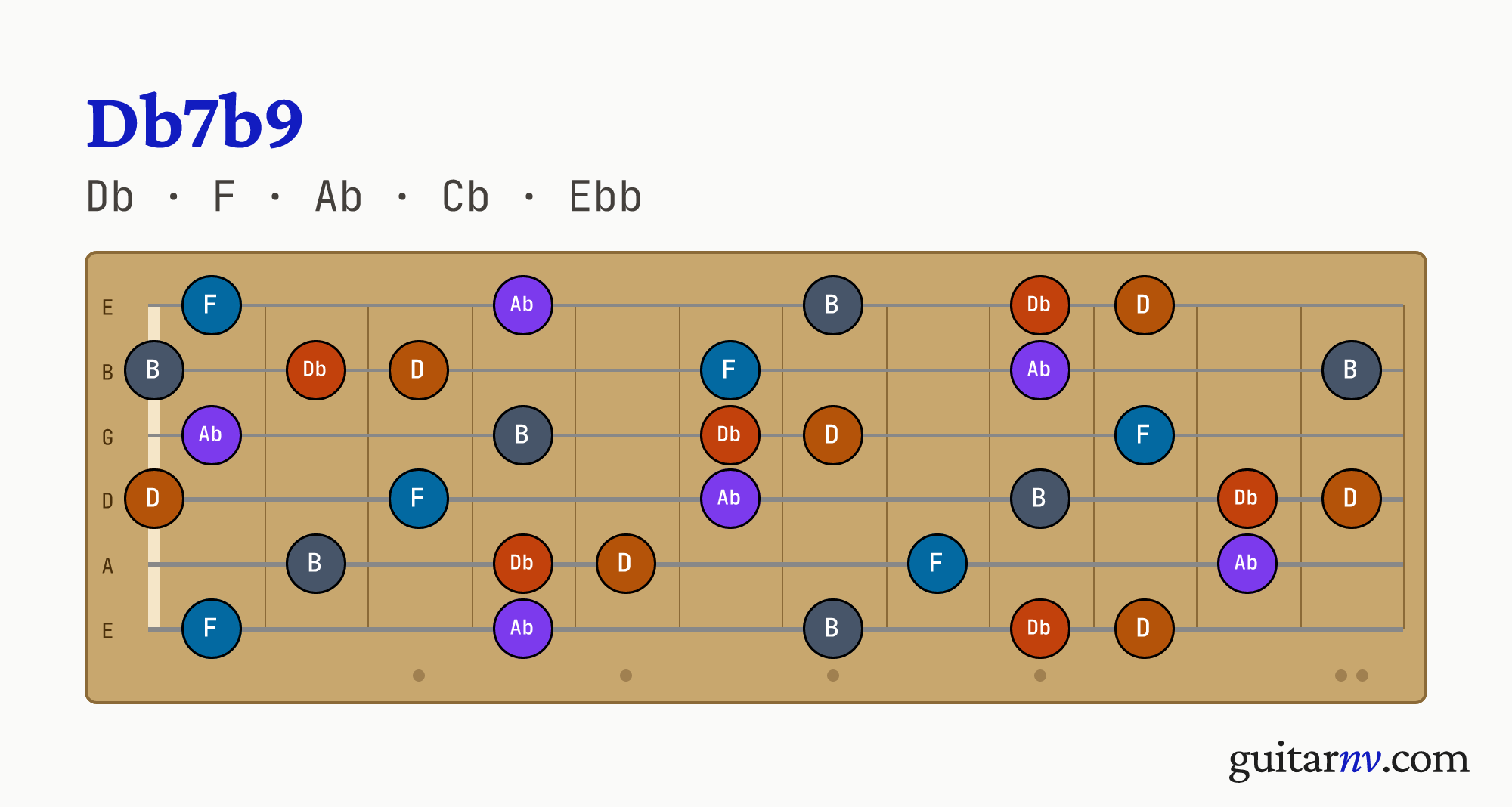
Adjust labels, frets, and palette in the interactive view.
About
The D♭7♭9 (D♭–F–A♭–C♭–E♭♭) alters the dominant 9 by lowering the ninth a half step. The E♭♭ creates a half-step clash with the root, amplifying the chord’s dissonance and intensifying its pull toward resolution. Because the interval between root and ♭9 is a minor ninth — one of the sharpest dissonances in tonal harmony — 7♭9 chords generate significantly more tension than standard dominants. They are especially idiomatic as V chords resolving to minor tonics; here D♭7♭9 → G♭m, where the ♭9 relates diatonically to the target minor key. The 3rd and ♭7 remain the essential harmonic tones; the ♭9 is the defining alteration. The 5th can be omitted.
Similar chords
Chords sharing two or more notes with this one, ranked by overlap.
Scales containing this chord
- A♭ Diminished (deg 4)
- B Diminished (deg 2)
- D Diminished (deg 8)
- F Diminished (deg 6)
- F♯ Harmonic Minor (V)
Scales whose notes include every chord tone. The Roman numeral (or scale degree) marks the chord root’s position in the scale.