A♭ Suspended 4th
A♭sus4
Notes
A♭ · D♭ · E♭
Intervals
- RootA♭ (1P)
- Perfect 4thD♭ (4P)
- Perfect 5thE♭ (5P)
Fretboard
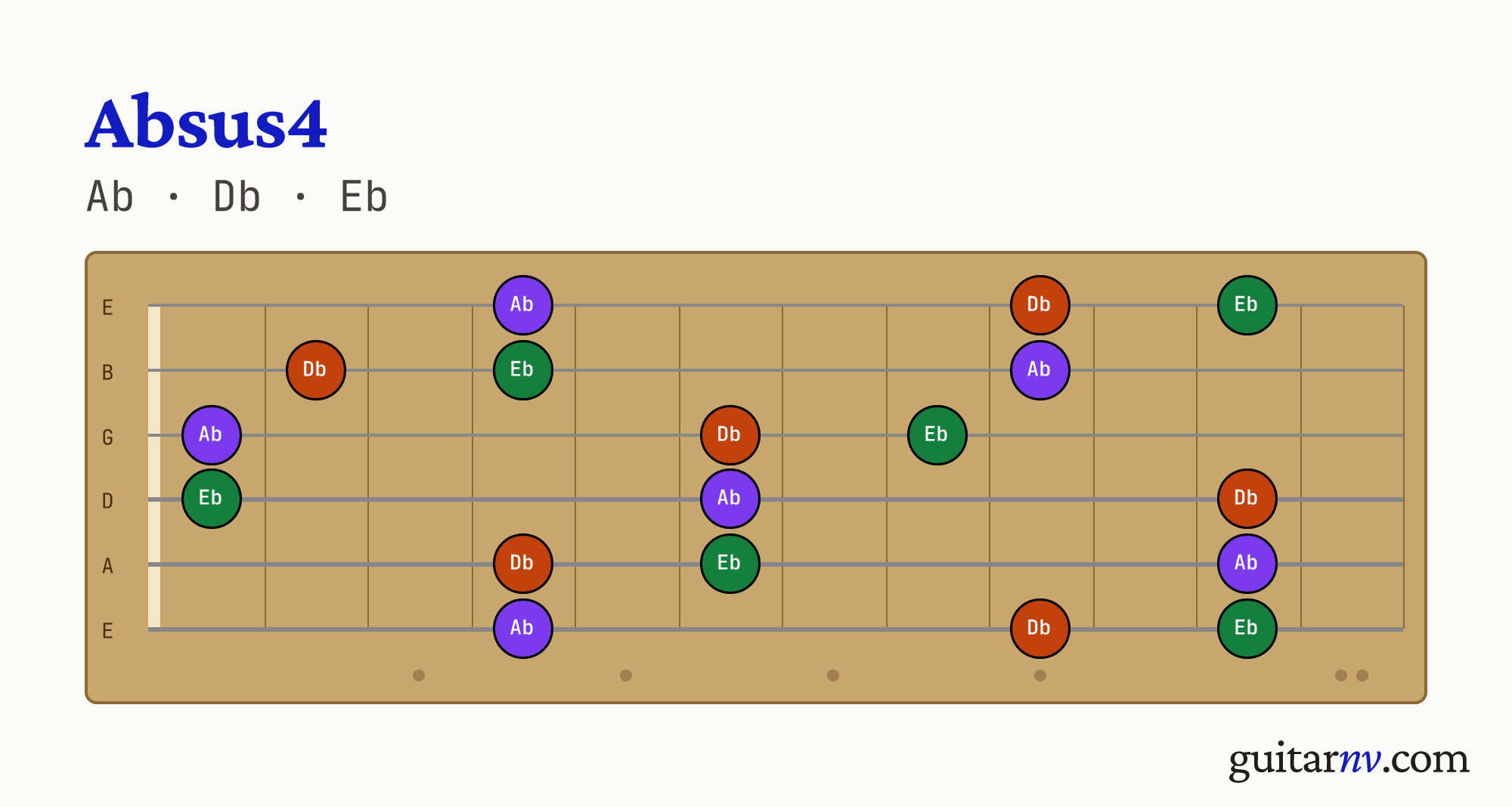
Adjust labels, frets, and palette in the interactive view.
About
The A♭sus4 chord (A♭–D♭–E♭) also replaces the third — this time with a perfect fourth. The fourth has a stronger gravitational pull than the second; in common-practice harmony it traditionally resolves downward to the third, making sus4 feel more like a delayed resolution than a neutral color. This makes it effective for rhythmic tension and release, especially in rock and gospel. The D♭ typically resolves to either A♭ (third raised) or A♭m (third lowered). On guitar the modification is often a single-finger addition or movement from a major shape; the fourth is the defining tone and must be present. Compared to A♭sus2, sus4 has a clearer sense of wanting to land somewhere.
Similar chords
Chords sharing two or more notes with this one, ranked by overlap.
Scales containing this chord
- A♭ Blues (deg 1)
- A♭ Dorian (I)
- A♭ Harmonic Minor (I)
- A♭ Major (I)
- A♭ Melodic Minor (I)
- A♭ Minor Pentatonic (deg 1)
- A♭ Mixolydian (I)
- A♭ Natural Minor (I)
- A♭ Phrygian (I)
- A Lydian (VII)
- B Lydian (VI)
- B Major (VI)
- B Major Pentatonic (deg 5)
- B Mixolydian (VI)
- B♭ Blues (deg 6)
- B♭ Dorian (VII)
- B♭ Locrian (VII)
- B♭ Minor Pentatonic (deg 5)
- B♭ Natural Minor (VII)
- B♭ Phrygian (VII)
- C Locrian (VI)
- C Phrygian (VI)
- D♭ Dorian (V)
- D♭ Harmonic Minor (V)
- D♭ Lydian (V)
- D♭ Major (V)
- D♭ Major Pentatonic (deg 4)
- D♭ Melodic Minor (V)
- D♭ Mixolydian (V)
- D♭ Natural Minor (V)
- E Lydian (III)
- E Major (III)
- E♭ Blues (deg 3)
- E♭ Dorian (IV)
- E♭ Locrian (IV)
- E♭ Minor Pentatonic (deg 3)
- E♭ Mixolydian (IV)
- E♭ Natural Minor (IV)
- E♭ Phrygian (IV)
- F Locrian (III)
- F Natural Minor (III)
- F Phrygian (III)
- F♯ Dorian (II)
- F♯ Lydian (II)
- F♯ Major (II)
- F♯ Major Pentatonic (deg 2)
- F♯ Melodic Minor (II)
- F♯ Mixolydian (II)
- G Locrian (II)
Scales whose notes include every chord tone. The Roman numeral (or scale degree) marks the chord root’s position in the scale.